
Trying to discover ancestors preceding the “brick walls” of two paternal grandparents’ illegitimate births was always going to be a challenge. Added to that was the warning from Peter Calver of LostCousins about endogamous populations: the common situation in which you share a single DNA segment with lots of people who all match each other, suggesting that any connection is likely to be a long way back. Nevertheless, it is fascinating to discover the families with whom there may be a connection. (Numbers in purple in the charts below denote missing generations).
My great grandmother Eleanor Cheshire‘s precarious upbringing, her subsequent life of poverty and her dubious liaisons led to the work house and even prison for neglect of her numerous offspring, most of whom died in infancy. This means that I have not identified my paternal great-grandfather yet.
I have traced Eleanor’s ancestors as far back as Thomas Cheshire (1759-1833). He married Jane Price in 1788 and both bride and groom were recorded as of St Mary’s parish in Shrewsbury, though they lived and died in Upton Magna. Lacking the usual evidence of a christening record, Thomas’ birth is a mystery. Ancestry family trees suggest John Cheshire (1739-1802) and Elizabeth Powell (b.1741) as parents of Thomas. Some claim their marriage took place in St Chad Shrewsbury whereas the record they reference shows both bride and groom were of the parish of St Peter in Worcester with no known connection to Shrewsbury. Some continue to report that Thomas Cheshire, born in 1768 to John and Elizabeth Powell went on to marry Jane Price despite the fact of his burial 14 days after his birth. John and Elizabeth are thus discounted as my 5th great grandparents. Will DNA reveal their identity?
Cheshire & Tennison in Maryland
It has been fascinating to follow the progress of brothers John (c.1631-1683) and Justinian Tennison (c.1629-1699) from Holland and Weymouth (or Yarmouth) as they travelled to Maryland in the United States. Their descendants appear in the Early Colonial Settlers of Southern Maryland and Virginia’s Northern Neck Counties website set up to reconstruct family trees for these early colonial settlers, sourced from published genealogies.
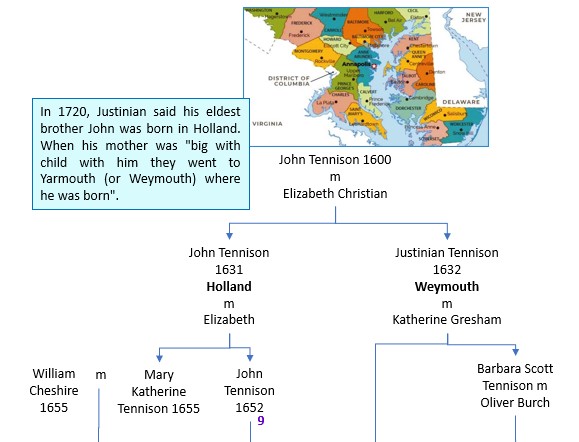
In his will, Justinian “Tennis” left one shilling each to his children Barbara, Mary, Katherine, Elizabeth, John and Sarah. He bequeathed “the little gun” to his grandson John Mansfield (Mansell) when he reached 21. The will was proved in July 1699 in Charles County by three witnesses and Justinian’s wife Katherine Tennis, executrix, posted a testamentary bond of 60 pounds sterling with Thomas Claxon and Thomas Simson as security. When Katherine died, Justinian’s estate was to go to his daughter Christian, whose name most likely derived from Justinian’s mother Elizabeth’s maiden name, though Montgomerie is another possibility.
The marriage of Justinian’s brother John’s daughter Mary Katherine Tennison and William Cheshire (whose family likely immigrated from Edlesborough) took place at St Clement’s hundred in St Mary’s county in 1676 and their descendants account for 11 of the 24 DNA matches. Mary’s brother John Tennison’s daughter Lucretia (Creasy) married into the Halsey family, as shown below.
Halsey & Wheeler in Flamstead / Cranfield
In 1577, Robert Halsey also known as Chambers married Ellen Barrett Alley aka Cooke (why the aliases?) in Flamstead. There was a double wedding when their son and daughter Robert and Ann married Ann and Thomas Wheeler of Cranfield. Another Halsey son Thomas married Elizabeth Phoebe Wheeler who was killed in an arson attack on settlers by Pequot Indians in 1649 in Southampton, Suffolk, New York.
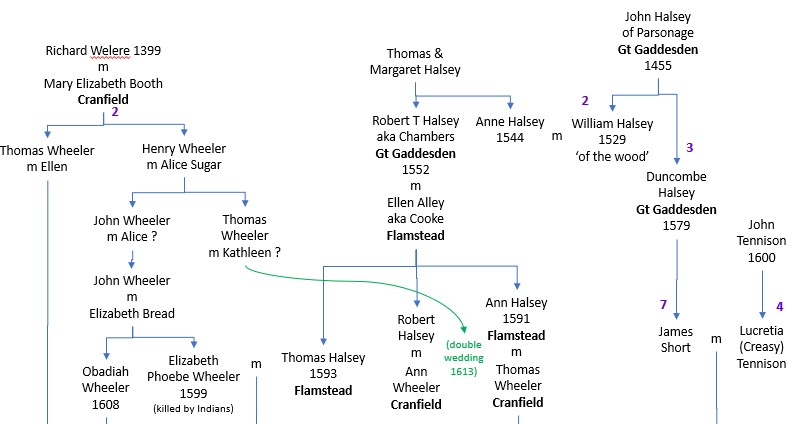
Raymond David Wheeler, the author of English Ancestry of Thomas Halsey of Southampton, Long Island is a descendant of Thomas Wheeler of Cranfield and Ann Halsey of Flamstead.
Putnam of Edlesborough
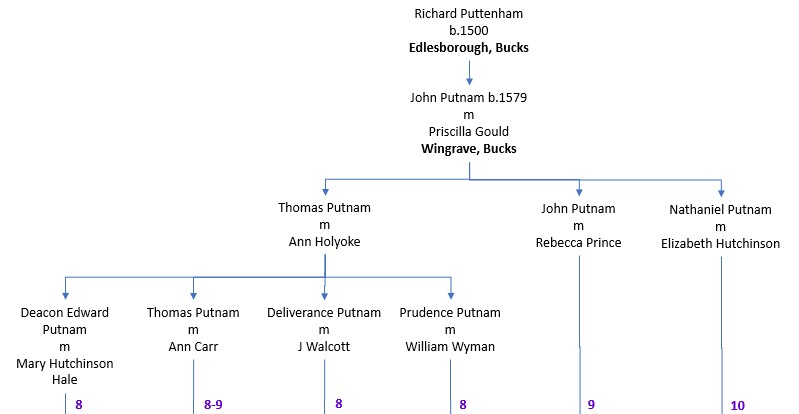
Putnam has appeared in several local slang forms including Puttnam, Putnam and the dialectally transposed Putman. Several descendants of Richard Puttenham, born 1500 in Edlesborough Buckinghamshire have appeared as my DNA matches eight to ten generations below this chart.
Cheshires in Edlesborough, Flamstead and Gaddesden
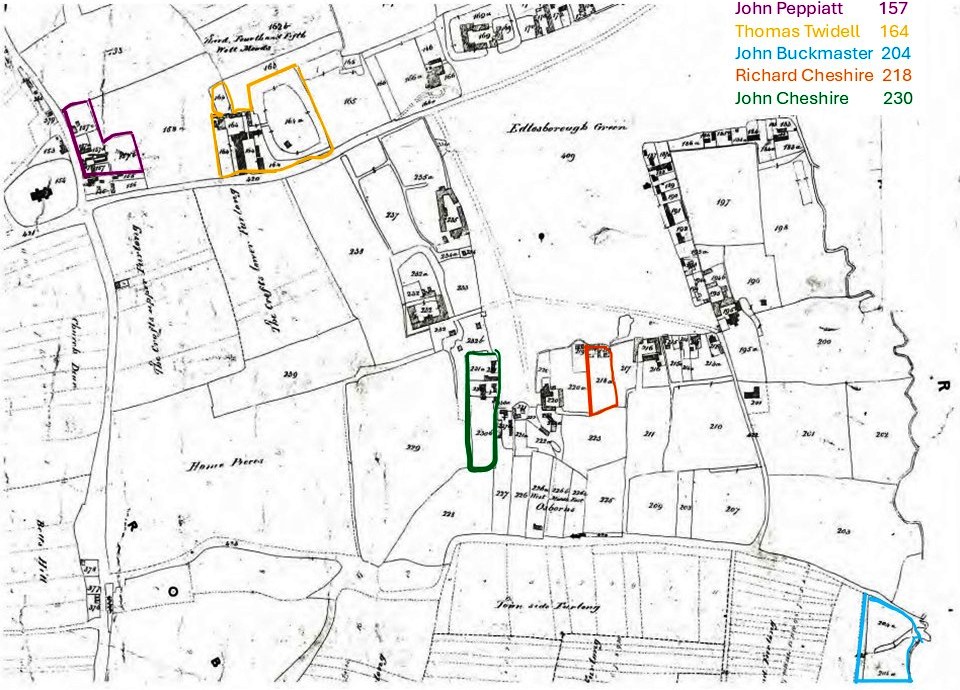
In Edlesborough 1815-1865: a study of village life (Jan 1970), Jane M. Komaromy describes parish life clustered around the village green with common rights of grazing and every piece of spare ground planted with plum trees which supplied good wine and jam. Straw plaiting provided extra income for women and children. There were three public houses in the village: The Greyhound, the Bell and the Axe and Compass. The tithe map for 1838 lists owners and occupiers of each piece of land and property in the village.
Thomas Cheshire (b.1699) married Lydia Peppiatt in 1735 in Edlesborough. In 1789, their granddaughter Lydia married Thomas Buckmaster by licence in Totternhoe. Their son Christopher Buckmaster was a miller and farmer at Doolittle Mill in Edlesborough (the third great grandfather of another of my DNA matches). He married Ann Buckmaster, cousin of another Christopher Buckmaster, tenant of Lady Alford, who farmed 782 acres in Ivinghoe.
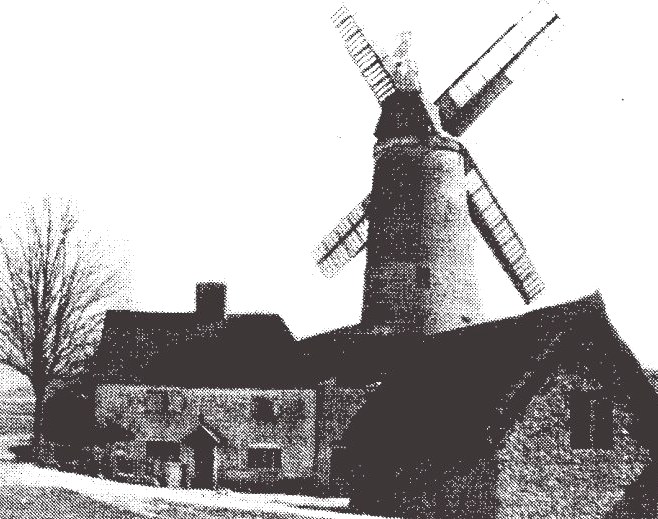
On page 15 of the study of Edlesborough village, “The Methodists at Edlesborough first gathered for worship in a barn belonging to Thomas Cheshire: they complied with the law by registering the barn with the Archdeacon of Buckinghamshire and paying the required fee of 2s.6d. In 1856 the churchwardens discovered that the tenant at Church Farm, Thomas Twidell, was a Methodist and had him evicted forthwith. He moved to a house he owned by the Village Green and used the land beside it to build the Methodist Chapel.” (plot 164 on the tithe map).
Thomas Twidell’s sister Fanny married John Peppiatt in 1816. John ran the Greyhound public house (plot 157) in 1838 and is described as a publican butcher there in the 1851 census. Their daughter Hannah married Lydia Peppiatt’s great grandson Edward Cheshire in 1850. He occupied plot 230a, next to his brother John’s beer shop, overlooking the village green. Richard Cheshire was a weaver who also lived on the green at plot 218a, next door to his daughter Hannah and her husband, church warden Benjamin Gray Jnr at plot 218.
Four more DNA matches descend from a complicated set of relationships between Deamer, Shepherd, Burgess and Cheshire families in the Flamstead and Gaddesden area.
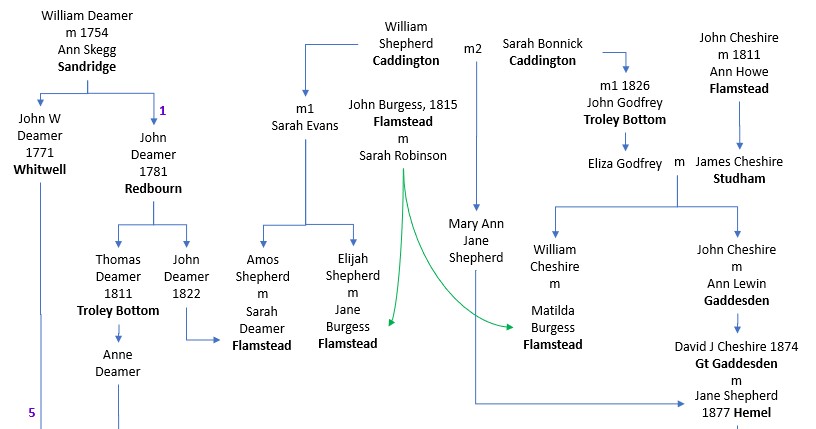
Many descendants of these families thrived, their surnames are familiar, their DNA matches mine but where is the connection with my family in Shropshire?
 Travels Through Time