
The development of the medieval market town of Berkhamsted presents a microcosm of what was happening in the rest of the country, emerging into a new age of industrialisation and facilitated by a growing network of roads, canals and railways. Increased production and efficiency brought major benefits, but also environmental consequences. It was in 1856 that Eunice Newton Foote published a paper that reported on her experiments with temperatures of various gas combinations and concluded that carbon dioxide and water vapour were heat-trapping gases which could one day cook our planet.[1] Indeed, we can find plenty of evidence that Berkhamsted has experienced some extreme weather conditions with headline-worthy stories of scorching heat and droughts, storms and floods, ice and blizzards appearing in local papers from 1825 onwards. Are these freak conditions or is the pot coming to the boil?
Scorching summers and droughts
Heatwaves nowadays are reported on maps with colours ripening over the years from blues and greens to livid orange and red (apparently to make them more accessible for people who are colourblind).
Looking back, there was too much of a good thing in 1825: “the thermometer at Berkhamstead… was 120 [49c] in the sun, and 84 [29c] in the shade”. Brooks and ponds dried up, cattle and crops suffered.[2] “Heat and want of rain is much felt in the Kitchen Garden. Potatoes, in some grounds, are almost baked by the solar heat.”[3]
One flaming July in 1904: “A rick of hay said to be the value of £200 [at] Pix Farm, Bourne End, Northchurch, was burnt to ashes… the sparks from passing trains ignited the grass &c. and the flames ran on and set the rick on fire. No water being near, the hay had to be sacrificed.”[4]
In the “singularly” hot summer of 1899, horticulturalist Edward Mawley, from his observatory at Rosebank, noted that “on no fewer than twenty-two days the temperature in shade rose to or exceeded 80 degrees [27c]. Favoured by the dry and sunny weather, the hay harvest was carried out with expedition and under the best possible conditions.”[5][6]

Reaping on Tunnel Field
Source: BLH&MS (DACHT : BK4518)
Drought followed long dry spells: “Wigginton was often short of water. Sometimes the only functioning well was at Champneys, a long distance from many of the cottages. In a terrible drought in 1856, a donkey cart was sent to Tring to fetch water.”[7]
You may remember the hot summer of 1976: “Now that the canal is literally in low water and not disturbed very much by large craft, the water is remarkably clear. One young unsuccessful angler complained that the fish could see him ‘a mile off’.”[8]
Storms and floods
A curmudgeonly King George II might once have defined the typical English summer as “three fine days and a thunder storm”, but storms certainly made good news stories.
In 1866, “The neighbourhood of Great Berkhamstead was visited by a violent storm… during which eighteen sheep and one cow, belonging to Mr. Haddon, of Rossway, were killed. The electric fluid passed through the house of Mr. Prudames, ironmonger, Berkhamstead, and struck the garden gate, which was torn from the hinges.”[9]
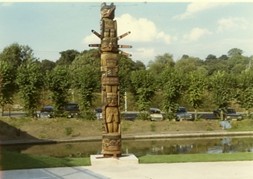
Thunderbird totem pole on a good day[10]
Source: BLH&MS (DACHT : BK11945_611)
It was lovely weather for ducks in 1879 when the effects of a storm were “unprecedented. The overflow from the Grand Junction Canal running across Mr. Hatton’s wharf yard, pushed a wall into the river Bulbourne, damming its waters and swamping the neighbourhood” and “one poor man who had about a score of rabbits had them drowned, while another, having ducks and chickens, lost the latter, the former being saved by their being in their element.”[11]
Was the Grim Reaper after a new scythe in 1882 when Mr. Longman’s gardener was struck by lightning in Ashlyn’s Park? “He was whetting his scythe under a tree, around which he was mowing, when the electric fluid struck the scythe, tore it from him, and knocked him down.” He suffered a scorched face, but was back at work after a day or two.[12]
A fortunate town in 1894… “The heavy rains of last week caused no damage at Berkhampstead, where floods are unknown” …was less fortunate three years later when “Attention was called to the flooding on Sunday morning of Provident-place, Berkhampstead.”[13]
In 1895, with hailstones the size of walnuts, “a thunderstorm of exceptional severity passed over Potten End, near Berkhampstead. The lightning was almost continuous, and the thunder deafening. The effect of the hail was fatal to the growing crops. Even birds were killed by the stones, many being seen under the trees next morning, dead. Upwards of 800 panes [of glass] were broken in the hamlet, not reckoning the chapel near the Plough Inn, which lost at least 200 panes.”[14]
There was another exceptionally heavy storm in 1907 where several mishaps occurred. “A thunderbolt descended near Ashlyn’s Hall and exploded before reaching the ground. An employee of Locke and Smith’s was partly stunned whilst at work. A horse which was standing in the High-street bolted, but was luckily stopped before anything serious occurred.”[15]
Ice and blizzards
Who remembers the winter of 1962-1963? Snow drifts against the front door, travel chaos, being sent home because outdoor toilets at school were frozen, the thrill of toboganning and cocoa when we got home. Children’s perspectives may differ slightly from that of farmers and snow-plough drivers. How did people cope in the past?
In 1874, there were “alternations of weather with changes very sudden and severe. There has been also another very great depression of the atmosphere, and, as usual therewith another hurricane. The variations from frost to mildness and rain, and from rain and wind again to strong frost, have been striking and remarkable.”[16]
In 1891, boats were “locked in the ice on the Grand Junction Canal, and the boys and others disport themselves thereon. Sledging has become the common mode of travelling.”[17] In the same year, the Farmers’ Journal reports “a new phase in the extraordinary character of the winter of 1890-91, and now we have four distinct phases in which it has been made a record… a long winter, a good six months of it… the longest and most severe frosts of the century… the driest February ever recorded… the heaviest snowstorms and blizzards ever known, and more disastrous than 1814, 1836, and 1881.”[18]
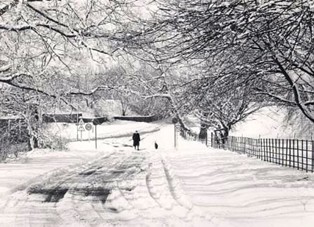
New Road and White Hill in snow; railway embankment on left
Source: BLH&MS (DACHT : BK8586)
Stranded at the station: “At Tring, on the North-Western line, the snow in the cuttings is as high as the carriages. Passengers waited at Berkhamstead all night, and the officials were in attendance all [the next] morning.”[19]
Reginald Short, the son of a canal lock-keeper near Lower Kings Road bridge remembered the canal being frozen for six weeks in Feb and Mar 1916. Time for the ice breaker “of strong steel construction with a flush wooden deck and a hand-rail fixed lengthwise at a height of about 4ft. Rocking the boat, the crew consisted of eight men, four on each side of the rail, and a steersman. The boat was pulled by up to eight horses hired from local contractors.”[20]
The new technology of the Industrial Revolution paved the way for accessibility to food at lower prices and succeeded the days when a good harvest could be the difference between life and death. Unpredictable weather has always shaped the British character and with fears of climate change, it looks set to continue to be an obsession.
Let’s end on a note to lift the spirits. In Jul 2022, the University of East Anglia headline was: “Study predicts growth in UK wine production due to climate change.[21] It’s getting warmer, so is there sparkling potential for our local vineyards? After all, Berkhamsted was one of only 38 places with vineyards recorded in Domesday Book (1086), probably near the Castle in those days. Henry Lane founded his nursery in 1777 near St. John’s Well “particularly acceptable to Vitis vinifera.” Mr Papadimitrio had a row of vines which produced grapes successfully for several years on the south-facing slope of Sunnyside allotments. Back in 1978, Percy Birtchnell wrote of “a rare sight in the countryside around Berkhamsted… the Frithsden vineyard”, involving “much hard work, heavy expenditure and constant vigilance, the end product depending largely on the weather”.[22]
[1] Thompson, C., ‘How 19th Century Scientists Predicted Global Warming’, JSTOR daily (Dec 2019), quoting The American Journal of Science (1856)
[2] Caledonian Mercury & Devizes Gazette (Jul 1825)
[3] Morning Post (Aug 1825)
[4] Bucks Herald (Jul 1904)
[5] Sherwood, J., ‘Edward Mawley VMH, horticulturalist 1842-1916’, Chronicle, vol.V (Mar 2008) and Willett, B., ‘Edward Mawley of Rosebank’, Chronicle, vol. XVII (Mar 2020)
[6] Herts Advertiser (Apr 1900)
[7] Birtchnell, P., Berkhamsted Review (Apr 1980)
[8] Birtchnell, P., Berkhamsted Review (Sep 1976)
[9] Hertford Mercury and Reformer (Jul 1866)
[10] According to legend, the bird winks during storms and sends flashes of lightning from its eye
[11] Bucks Herald (Aug 1879)
[12] Bucks Herald (Jul 1882)
[13] Bucks Herald (Nov 1894 & Jul 1897)
[14] Leighton Buzzard Observer and Linslade Gazette (Aug 1895)
[15] Buckinghamshire Examiner (Jul 1907)
[16] Bucks Herald (Dec 1874)
[17] Bucks Herald (Jan 1891)
[18] Bucks Herald (Mar 1891). The winter of 1813-14 was so harsh that the River Thames froze over and supported the great Frost Fair.
[19] Morning Post (Jan 1881)
[20] Birtchnell, P., Berkhamsted Review (Apr 1985)
[21] University of East Anglia (UEA), Study predicts growth in UK wine production due to climate change (8 Jul 2022)
[22] Birtchnell, P., Berkhamsted Review (Feb 1978)
 Travels Through Time