
From the late seventeenth to the early nineteenth centuries, judges operated within a legal framework in which the penalty for committing a felony was death.[1] If they worked within the letter of the law, the “bloody code” (as it was later dubbed) appeared harsh, but there was room for manoeuvre and sentences were often commuted. Part of contemporary thinking (influenced by the French Revolution) was that the lower orders must be identified as the criminal classes and the landed elite (the class to which judges belonged) must be protected. There was experimentation with new forms of punishment, while some tried and trusted methods were closed down at a moment’s notice. Judges needed to adapt to these changes and we can observe the emergence of “let the punishment fit the crime”, so important to us today. Study of cases at the Old Bailey paints a picture of punishments meted out during this period and contemporary newspapers help to provide a view of life from the judge’s bench.
Many cases did not reach court in the first place; the harshness of a legal framework centred on capital punishment prevented victims from prosecuting felons from fear of reprisals or simply the trepidation of being the cause of someone’s death. The designation of “bloody code” denoted the increase in the number of capital offences, including those crimes that the poor perpetrated on the property of the rich, and had reached about 200 by 1820. However, the actual number of those sentenced to death was less than 25 per cent of the total punishments per year (see graph below).
Why was this? It was thought that the gruesome spectacle of public hangings performed by government officials was having a destabilizing effect on society. Despite its ability to engender terror in the individuals who had to face such an ignominious end, capital punishment was not working as a disincentive to crime. There had to be a different approach and from 1818, crimes defined as capital were reduced again with Peel’s reforms in 1827.
Old Bailey cases 1700-1900: number of punishments by year

Notes: American War of Independence interrupts transportation 1775-1783
Transportation to Australia 1788-1853
End of Napoleonic War triggered rise in crimes from 1815
Dismantling bloody code from 1827 resulted in rise in committals
Larceny re-classified as misdemeanour, causing fall in felonies from 1853
Crime rates overall reduced following Crimean War 1854
Source: Old Bailey online; miscellaneous, no punishment, unknown omitted [2]
Capital offences
John Tawell appears in the Old Bailey trials in 1814, pleading guilty that he “feloniously, and without lawful excuse had in his custody and possession a forged bank note, for the payment of 10 l. he knowing it to be forged”.[3] He was transported to Australia for 14 years. By 1841 Tawell was living at the Red House in Berkhamsted High Street with his Quaker wife Sarah and four servants. He had managed to obtain a ticket of leave and became rich as a chemist in the new colony of Sydney before returning to England. Afraid that his illicit relationship would be discovered, he murdered his mistress Sarah Hart by administering prussic acid. Though he escaped the scene of the crime, he was arrested as a result of telecommunications technology.
He was hanged in Aylesbury in 1845.[4] Evidently, a hanging was still a draw for crowds of ghoulish onlookers. Tawell left his widow with difficulties over the ownership of the Red House in the High Street, as all property of a convicted felon reverted to the Crown.[5]

The end of the American and French wars triggered crime waves in 1783 and 1815 respectively. Soldiers returned with guns and horses, the essential tools of the highwayman, perhaps to prolong the excitement of conflict.
Berkhamsted’s own notorious highwayman, James Snook, stopped and robbed the mail on the turnpike and was hanged on a nearby tree and unceremoniously buried. Next day, the body was dug up, laid in a coffin, and re-buried on Boxmoor.[6] This happened in the days before suspected criminals had to be proved guilty “we must not hang him or pillory him without proof before a jury”.[7]
At the Hertford assizes in 1798, when Richard Seare (20) and Thomas Wood (16) were tried for burglary at John Baker’s house, a hosier at Berkhamsted, and received sentence of death.[8] Their accomplice gave evidence of them also robbing a house at Wooburn. They sold their ill-gotten gains (worth £200) to James McCoull in London, for 14 guineas. McCoull was subsequently tried at the Old Bailey for receiving stolen goods (itemised as a large quantity of muslins, calicoes, shawls, &c.) but was found not guilty due to lack of witnesses other then Baker and the accomplice.[9]
Transportation
Some statutes opened up new options for sentencing. The 1718 Transportation Act was passed because punishments against robbery, larceny and stealing money and goods had “not proved effectual to deter Wicked and Evil-disposed Persons from being Guilty of the said Crimes”.[10] The American War of Independence meant Britain could no longer offload convicts there. This was a crisis for criminal justice – what were they to do? Should they revert to capital punishment?
It was in 1787 that, with great relief, it was decided that populating British colonies in Australia would solve the problem. A sentence of transportation was for seven years with the emphasis on suitability for life in a distant colony rather than on the severity of the crime, hence the modern perception of the wickedness of being “transported for stealing a handkerchief”. When the only other option was hanging, judges were giving these people another chance.
As we have seen in the Seare and Wood case, clothes or the wherewithal to make clothes, such as various types of material, ribbon and lace, constituted 72 per cent of the goods stolen, most often from shops or houses. The majority of thieves were either caught in the act or in possession of the stolen goods, either by the victim or with the help of unpaid parish constables (in the absence of an official police force). Bundles of clothes were hidden under coats or petticoats, smaller items secreted into pockets or even “down her bosom”. Some thieves had the nerve to wear the stolen items of clothing whilst others were witnessed disposing of their cache. In nearly all cases the thefts were carried out without violence; one or two victims sustained minor injuries in their efforts to constrain the offenders.
William Garrow helped George Pitt to escape conviction for deception in the process of his bankruptcy in 1794.[11] Pitt allegedly hid merchandise from his creditors, namely, 203 yards of black lace valued at over £28, 40 pairs of silk stockings (including “twelve pair of mens spun silk stockings”) at over £13, “a great variety of other goods”, and 31 pawnbrokers’ tickets, “with intent to defraud his creditors, against the statute and against the King’s peace”. Mr Earl of Berkhamsted was called to give evidence that Pitt had bought lace from him. As an indication of the popularity of lace-making as a cottage industry at the time, there were three lace-merchants in Berkhamsted, including Richard Earl.[12]
Today’s canal looks so peaceful, it’s hard to imagine it was once a hub of commercial (and criminal) activity. In 1803, Thompson (19) and Gibbert (20) were transported for seven years for feloniously stealing 140 yards of printed calico, value £17 10s from Messrs Pickford’s (removals firm) boat as it passed through Berkhampstead. Thompson and Gibbert were boatmen on board. William Bailey, saddler and harness-maker in the town, made an offer for a sick horse that Thompson was leading to the Cow Roast. Thompson spotted his chance to make some money from Pickford’s cargo. Given the clandestine arrangements for meeting Thompson and Gibbert and the nature of a sample of the goods, Bailey perceived that the calico had been come by dishonestly and alerted the constable. The boatmen were staying at the Goat to feed their horses, so Bailey and the constable pursued them there, apprehended them; they were taken before a Magistrate, and committed.[13]
Residing at the Berkhamsted workhouse in 1851, twenty-year-old Joseph Grover was charged with stealing a smock-frock and two handkerchiefs, the property of James Reynolds.[14] The Deputy-Chairman was stern in his rebuke to Grover: “Your offence is aggravated by the circumstance that you were… provided with food and clothing, and that you robbed a poor man who was sleeping with you”. Groves was imprisoned for six months hard labour, with solitary confinement for a week in each month. It would be transportation for him if he re-offended.
Hulks
In the search for alternatives to death and transportation, this was a time of experimentation with forms of punishment and perhaps there was an air of desperation in the way decisions were made. The response to the sudden loss of British colonies in America in 1776 prompted an act to “alter the punishment of felons from transportation to hard labour on the River Thames to Woolwich and Deptford, to make a new kind of hulk… a vessel built on a new construction; the plan of which has been approved by His Majesty in Council, and the Lords of the Admiralty”.[15] By March 1778, debate was underway in parliament about hard labour on the river being more severe than transportation. It still had not the desired deterrent effect; robberies were on the increase. Prisoners were “too well fed” and received money from “particular ladies of the town who, as they got their money easily, were known to be generous”. As many prisoners were ill aboard the hulks, there were suggestions that other places in America or Canada could be used for transporting felons. Though the hulk act under discussion was a temporary law, it had to stay until something else could be substituted.[16]
Further investigation of the circumstances of confinement aboard hulks followed and observations were reported in June 1778. The death of a quarter of those confined was attributed to the “disordered constitutions to which the profligacy of criminals generally exposes them… and partly to the epidemical fevers to which all places of confinement are subject; but most especially vessels, instituted to collect the refuse of the several dungeons of the kingdom.” Modifications were made to the bill to address health issues and shorten the terms of sentence.[17]
Experimentation was still on the agenda in 1779, when the hulk act was declared “inefficacious, and by no means equal to the end proposed”. A reversion to the old custom of transportation was suggested, even though America was no longer available; the East India Company could employ the “least guilty of the youthful convicts” as soldiers for five years and the West Indies plantations might welcome cheaper labour.
In 1841, Elizabeth Thorn (47) and her 11-year-old son Jesse were in Berkhamsted workhouse. In 1837 her husband George Thorn was on the prison hulk Fortitude. The gaoler’s report states that he was a labourer of bad character and indifferent connections. He had been convicted three times and imprisoned twice before he was convicted of housebreaking and stealing flour and transported on the ship Waterloo for life to New South Wales, Australia. After a string of offences (stealing a gown in Wigginton, passing bad money and stealing a pale), Elizabeth was transported for seven years on the ship Emma Eugenia and died in Launceston Tasmania in 1847.
Imprisonment
Imprisonment became the punishment of choice for the rest of this period and beyond. The gaols and bridewells of the eighteenth and nineteenth centuries were just temporary holding pens for minor offenders such as debtors and vagrants or those awaiting trial or execution. Many (including Berkhamsted’s) were inadequate, with insufficient safeguards against escape and little thought was given to the health of inmates; these cramped, airless holes were the breeding ground for infectious diseases such as “gaol fever” (typhus) that was so easily spread by lice. Many victims of crime were satisfied that their attackers had suffered punishment enough by incarceration in these dungeons and failed to press their cases to conclusion.
A local example was in 1840, when “A poor man named Cave was… committed to Berkhampstead gaol by Rev. Mr. Mountain, a Hertfordshire magistrate, on a charge of barking trees, an offence which amounted to felony, if the injury done was to the extent of 20s. or upwards”.[18] Evidence was vague, but Cave was committed for re-examination after seven days, being kept on just bread and water in the meantime. When the case was brought to the petty sessions, Cave was immediately discharged. Questions were raised about the rich and powerful Rev. Mr. Mountain’s judgement and “by what authority a man, not convicted, was kept in prison for seven days on a diet inferior to that allowed to already convicted felons?”
Property had to be protected and many privileges previously conferred by the lord of the manor on to the poor, such as gleaning, the collection of fallen wood, fishing and hunting game, were criminalised.
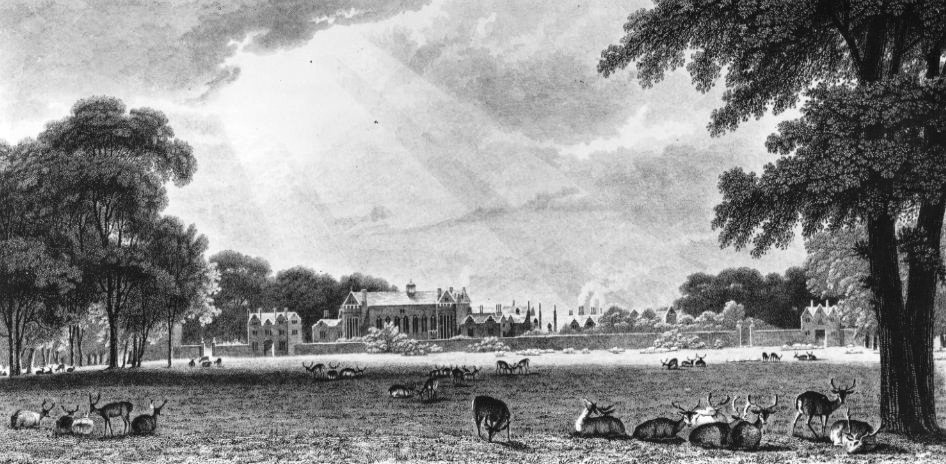
Following repeated acts of poaching at Lady Bridgewater’s estate at Ashridge in 1836, including some daring outrages attributed to workmen employed on the Northern Railway, police officers and constables sallied forth, armed with cutlasses. A body of 37 men of athletic appearance, armed with large clubs and staves and attended by dogs, were driven from cover on to a common, at which point they threatened to fell anyone who made an approach. Five prisoners were captured by a surprise attack from mounted constables, which prompted a general melee, whereupon all of the men fled towards Berkhamsted, hotly pursued for some miles by horsemen and constables.
Source: BLH&MS (DACHT : BK11945_73)
Exhausted prisoners were rounded up and taken to Lady Bridgewater’s where magistrates were sitting; seventeen were severally fined, or committed for three months to Hertford Gaol if they were unable to pay. Escapees entered Berkhamsted in a deplorable state: “[Benjamin] Warren is most seriously wounded, and has completely lost the sight of one eye, the ball of which was penetrated by a shot.”[19]
Other punishments
Statutes were passed to correct problems with some other forms of punishment, such as burning of women and the pillory. Burning of women had been justified on the grounds of propriety “the decency due to the sex forbids the exposing and publicly mangling their bodies”.[20] The Times commented: “Must not mankind laugh at our long speeches against African slavery, and our fine sentiments on Indian cruelties, when… we roast a female fellow creature alive for putting a pennyworth of quicksilver on a halfpenny worth of brass.”[21] Questions were raised in the Commons when people died from being pelted in the pillory.[22] This raised awareness of the dangers of the mob taking the law into their own hands, yet the pillory was not formally abolished until 1827.
Corporal punishment by whipping reached an all-time high in 1784. This had been a fairly common form of punishment in Berkhamsted; it was possible to buy a whip o’ nine tails for a shilling in 1760. In 1814, John Pudd was paid 3s 6d for whipping a man at the stocks, probably in full view of people stopping by at the old market house for their vegetables.[23]

Source: BLH&MS (DACHT : BK11554)
Nash remembered the village stocks, which were used by Bourne School boys “to give them a taste of this wholesome discipline, without the fee of one shilling, that being the legal charge of the parish constable for placing a drunken man in a place of conspicuous safety”.[24] The public whipping of females was abolished in 1820, but private whipping was equally abhorrent, as evidenced by the cruelty inflicted in workhouses and lunatic asylums.[25]
In conclusion, judges moved with caution to adopt new methods of punishment such as the hulks on the Thames and were slow to realise the loss of the American colonies. However, the prospect of colonizing New South Wales was received enthusiastically by government and judiciary and this method was effective for many years in ridding England of its worst offenders.
What may appear to us as frankly bizarre sentencing practices constituted the modus operandi of the eighteenth and nineteenth centuries but this appears more logical and consistent once the prevailing politics and pressures are better understood. Young boys faced extraordinarily severe punishments for petty offences that nowadays would scarcely warrant a caution. Women were transported in their thousands for stealing a few scraps of food or linen. In the majority by far were the men whose acts of desperation or gratuitous violence led them to whipping-post, gallows or “beyond the seas”. As early as May 1784, Robert Peckham the Lord Mayor of London stressed the importance of proportionate punishment and clear evidence when he advised the jury:
… whoever is proved to be guilty of that offence, should be brought to the punishment they deserve; but… it is equally important… that innocent men should not be fixed with a crime so atrocious in its nature, and so penal in its consequences…[26] This failed to convince the jury, but Mr Garrow was defending.[27] Perhaps it was from this speech, or from men with Peckham’s frame of mind, that he gleaned the idea that he allegedly promoted: that the punishment should fit the crime.
[1] Felony in common and statute law was “the general name for a class of crimes which may loosely be said to be regarded by the law as of a graver character than those called misdemeanours” (Oxford English Dictionary). Felonies included treason, murder, rape, arson, robbery, burglary, forgery, horse stealing, picking pockets and grand larceny. Misdemeanours were dealt with under a magistrate’s summary jurisdiction.
[2] Old Bailey Proceedings Online 1674-1913 (henceforth OBP in footnotes)
[3] OBP, ‘John Tawell’, ref: t18140216-58 (16 Feb 1814)
[4] Statham, T., ‘John Tawell (1784-1845)’, Chronicle, Vol IV (Mar 2007),
pp.11-14
[5] Boakes, J., ‘The Red and White House’, Chronicle, Vol XVII (Mar 2020), p.41
[6] The Sketch (08 Feb 1899)
[7] Bradford Observer (Oct 1850). This was put forward as one of the six reasons why “crime stalk[s] abroad so signally unchecked”. Another reason was the lack of police: “a policeman is not ubiquitous – if you know he is walking towards Berkhampstead you are certain he is not going towards Hemel Hempstead”.
[8] Hampshire Chronicle (Mar 1798)
[9] OBP, ‘James McCoull’, ref: t17980418-13 (18 Apr 1798)
[10] J. Baskett (printer), An Act for the further preventing robbery, burglary, and other felonies… (London, 1718), p.1
[11] OBP, ‘George Pitt’, ref: t17940115-58 (15 Jan 1794)
[12] Universal British Directory (1791)
[13] OBP, ‘Benjamin Thompson, Richard Gibbert’, ref: t18030112-49 (12 Jan 1803)
[14] Hertford Mercury and Reformer (May 1851)
[15] Morning Chronicle & London Advertiser (18 Jul 1776)
[16] London Chronicle (6 Mar 1778)
[17] Morning Chronicle & London Advertiser, issue 2834 (20 Jun 1778)
[18] The Champion (Apr 1840)
[19] Sheffield Independent (Dec 1836)
[20] Blackstone, W., Commentaries on the Laws of England (1774), vol.4, p.93
[21] The Times (24 Jun 1788)
[22] Gentleman’s Magazine (April 1780), pp. 243, 245
[23] Constables’ Accounts (7 May 1758)
[24] Nash, H., Reminiscences of Berkhamsted (1890), pp.14-15
[25] Morning Chronicle (30 Jun 1820)
[26] OBP ‘Thomas White’, ref: t17840526-3(26 May 1784)
[27] Some may remember Garrow’s Law, TV series 2009-2011, showing how William Garrow tried to make the law work for those unable to help themselves.
 Travels Through Time