
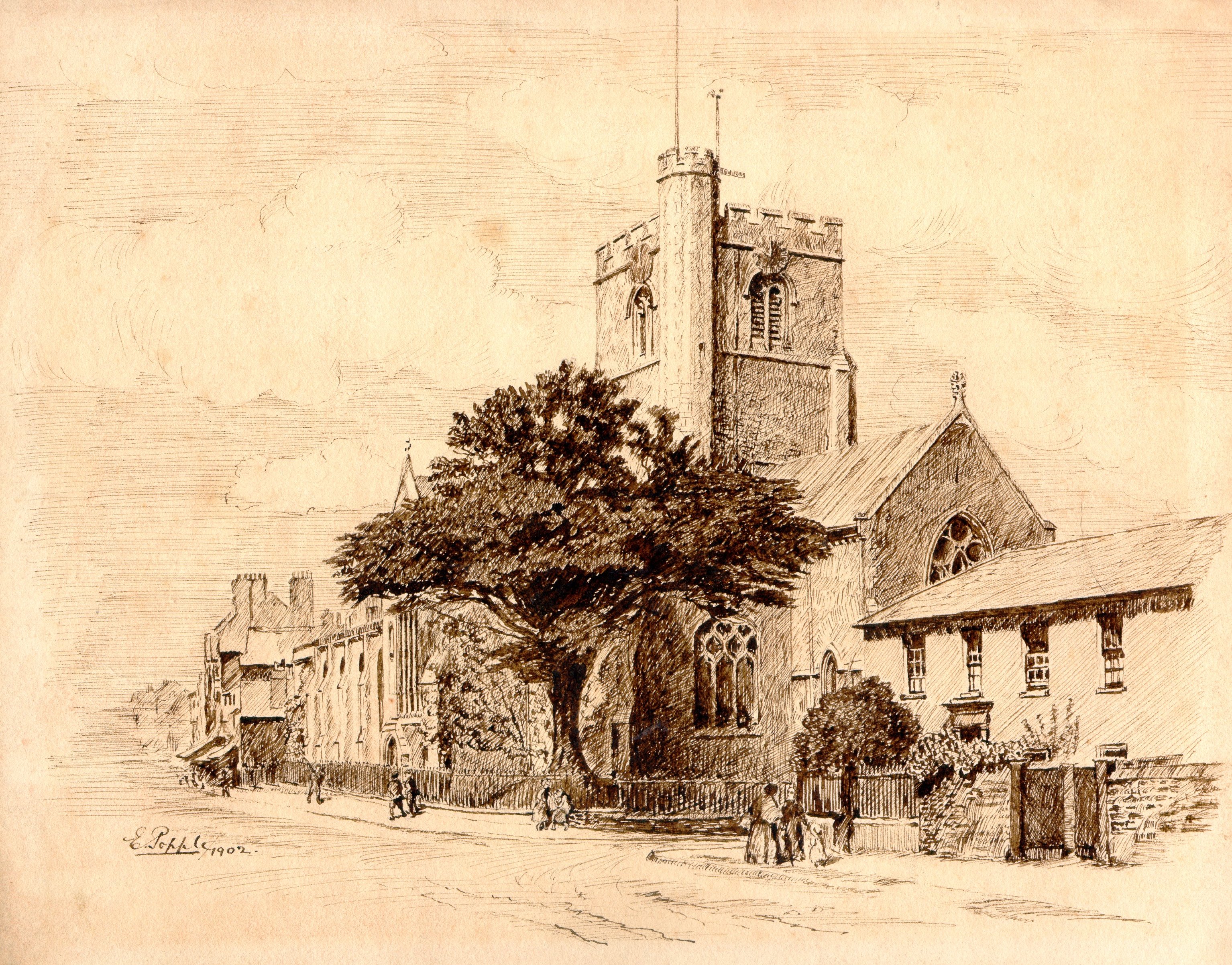
In several editions of the Berkhamsted Review, Beorcham wrote of various features of the church.
St Peter’s Hall… “great efforts were made to provide this hall. The scheme was first announced in the late 1920s, and fund-raising was hampered by the worst slump of the century. A healthy contribution was expected from a pageant held in the Castle grounds in 1931, but it was not a great financial success. Nevertheless, the building committee plodded on, and in April 1933 the Bishop of St. Albans performed the opening ceremony and enjoyed the hall-warming party. St. Peter’s Hall was very popular. It was a hive of activity. Goodness knows how many pleasant evenings I have spent in the 43 years old hall” (Sep 1976).
Seating capacity… “In Kelly’s Directory for 1902 the church was credited with 1,100 sittings. Kelly claimed that St. Peter’s… was the largest church in the country next to St. Albans Abbey, but he also credited Hitchen parish church with 1,300 sittings. Perhaps a different yardstick was used than seating capacity” (Sep 1981).
A Saxon doorway?… A guide book published by a famous motoring organisation [advised visitors] to see the Castle ruins, St. Peter’s Church (Saxon doorway) and 17th century almshouses. I would very much like to see that Saxon doorway. Can anyone tell me where it is? Perhaps we could form a search party (Feb 1976).
Bourne’s Day… Birtchnell wrote about the Bourne scholars, for whom December 16th was a great day, when they benefited from an 18th century charity. In 1886 the parish magazine reported the annual service at St. Peter’s Church, followed by a dinner at the King’s Arms and a pilgrimage to the top of the church tower: “From the church the managers of the Trust, the clergy and the children walked in procession to the King’s Arms, where they were met by some of the ladies who take an interest in the charity, and all sat down to a good old-fashioned Christmas dinner. Whilst the managers were transacting their business, the children went up the church tower, and derived great amusement from watching the Christmas market, especially the wilfulness of some of the sheep and pigs, which seemed to have a kind of presentiment of their purchasers’ intention of turning them into Christmas dinners for the people” (Dec 1983).
The town’s best viewpoint… In Jun 1984, Birtchnell described his own trip to the summit: “One evening in May, thirty or so members of the Citizens’ Association scaled a hundred or so stone and wooden steps to see the bells and enjoy the views from St Peter’s Church tower. My first journey into outer space was made when I was a young schoolboy. Edward Popple, our headmaster, gave us a summit talking-to if we started shouting or leaning too far over the battlements. He was relieved when we returned safe and sound. No one had fallen overboard and dented the nave roof. The bird’s-eye views of the town have never lost their interest. There are good scenes for photographers in every direction, and one is scarcely aware of the noise of the traffic below.”
Cowper’s window… “A Chelmsford man… great admirer of William Cowper, was puzzled by the great east window which, over a century ago [1872], was completely and beautifully reglazed as a memorial to the poet. But every panel is clearly visible except the one depicting William at his prayer desk with his tame hares. Many people wish that this panel was not obscured. A few years ago, when Songs of Praise was filmed and recorded in St Peter’s, the BBC photographers climbed ladders in the hope of showing the Cowper panel. The result could best be described as a squint” (Oct 1984).
The bells of St Peter… A Ringing World article quotes a rule of 1870 that “there are to be eight stated ringers and four probationary ringers; a fine of 2d. for each non-attendance is to be deducted from the ringer’s salary, and the salary is on no account to be spent in needless feasting and drinking” (Jan 1973).
Music in the air… “In 1940 the ringing of church bells was limited to sounding an invasion warning. One very bright day in July, 1940, the parish was startled by the tolling of a bell at St Peter’s. What happened was a warning by an Observer Corps unit that some objects in the sky looked suspiciously like parachutes. It was soon ascertained that Hitler’s invaders were puffs of smoke from rocket signals fired experimentally at Brocks’ works, Hemel Hempstead” (Apr 1983).
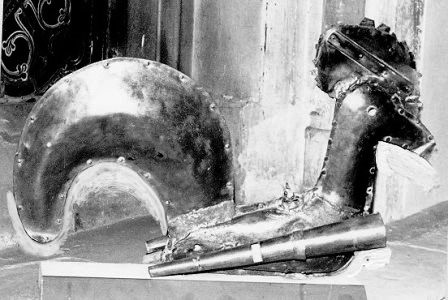
The whistling weathercock… “could once be heard as well as seen. Metal tubes fitted to the wings of the ‘bird’ emitted a piercing whistle in high winds – an eerie and monotonous dirge which brought so many protests from High-street and Castle-street residents that the weathercock was rendered speechless” (Apr 1947).
 Travels Through Time