
Whigs and Tories were terms of abuse in 1679 (respectively horse thieves and papist outlaws) during the struggle to prevent James II attaining the throne. After 1784, Pitt the Younger led a new Tory party for country gentry, merchants and administrators; Charles James Fox led a new Whig party to represent religious dissenters, industrialists and reformers.[1] At that time, the Hertfordshire constituency returned two members of parliament. Most voters were freeholders and others who could meet property requirements.[2]
It was the Whigs who took the first steps towards democracy and away from rule by aristocracy and landed gentry. In 1797, Lord Grey was keen to exclude from the House of Commons those “without property, without industry, and without talents” who were nominated by great men to promote their own interests. In helping to draw up the Reform Bill of 1832, Grey advised that those of “high station and property” would retain their position not by bribery but by earning the good opinion of fellow subjects; he wished to establish the right of representation, not of nomination.[3] At the same time, Lord Russell had an aversion to secret voting; most Whigs believed it would lead to corrupt and self-interested behaviour; an open vote meant “an elector would act with deliberation and responsibility”.[4]
Henry Nash recalled the excitement and gaiety in Berkhamsted that greeted the passing of the Reform Bill in 1832:
Streamers were floating from various points bearing the inscriptions of “Grey for ever !” and “Russell for ever!” Party strife had ceased, and for a while Whigs, Tories, and Radicals were blended into one harmonious whole [with] feasting and rejoicing.[5] [6]
Until 1872 parliamentary elections were publicly declared, with votes being recorded in poll books at the hustings.[7] To start with, eligible voters were men aged 21 and over owning land worth forty shillings (£2) a year. This amount had been fixed by an Act of 1429 to cut out “a great, outrageous, and excessive number of people, of which the most part was people of small substance and no value… [who] pretended a voice equivalent to… the most worthy knights and esquires…” leaving about 247,000 voters in 1832.[8]
Following the Reform Act, Hertfordshire returned three members to parliament. The 1832 poll book for the county lists all the voters in Great Berkhampstead (79 registered of whom 74 voted) and Northchurch (36, 32 voted).
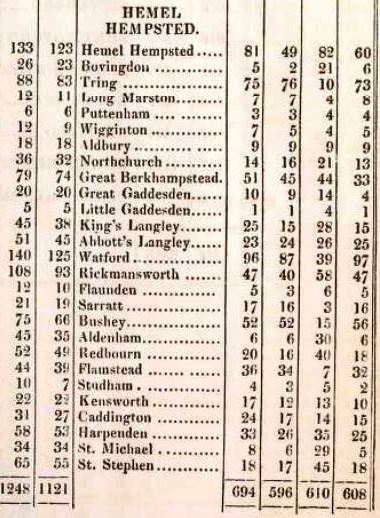
Four candidates stood for election that year: Sebright, Calvert, Grimston and Alston. Sir John Saunders Sebright of Beechwood near Hemel Hempstead was independent but with Whig tendencies. His name appears along with Augustus Smith as stewards at the first dazzling ball of the 1830 season at Berkhamsted, with spirited dancing to Weippert’s Band.[10] With “more than its usual patronage” the Earl and Countess of Verulam were also in attendance; the 2nd Earl of Verulam Viscount James Grimston was the Tory candidate at the election.

In the same year Nicolson Calvert of Hunsdon, Whig, had supported the county’s petition for the abolition of slavery.[11] He was reluctant to stand for the 1832 election on account of his age (he was nearly 67 at the time). Although he trailed in the Hemel district, he was one of the three MPs elected, along with Sebright and Grimston; Rowland Alston was elected to represent Hertfordshire in 1835.
Many well-known Berkhamsted names appear in the list of 1832 voters: William Claridge of Grubb’s Lane (proprietor of houses but also photographer, now Chesham Road), Astley Paston Cooper of Whitehill, Rev. John Crofts at the Rectory, Thomas Dorrien at Haresfoot, Henry Lane (nurseryman), William Littleboy (maltster and miller) at Bourne End, Frederick Miller (later of Pilkington Manor) owner of freehold houses in Red Lion Yard, John Manship Mills (brewer), John Page at the Kings Arms, Obadiah Pocock (blacksmith), John Siret at the Goat, Richard Steel (surgeon) in High Street, James Smith at Ashlyn’s Hall.
In Northchurch meanwhile, voters included: James Duncombe of Woodcock Hill, Thomas Friend at Haxter’s End, William Geary of Cross Oak Farm (owner of Marlin’s Farm), Thomas Landon at Cow Roast, W John Clark Moore living at Windsor Castle and Augustus Smith of Ashlyns Hall jointly renting out New Lodge, Joseph Redding of Harr[i]et’s End, Rev. J.H. Clerk [Culme] Seymour at the Rectory Northchurch and Robert Sutton of Rossway.
In 1836, there was a demand for ten more polling places, including Berkhamsted, not to gain “trumpery advantage” but for the convenience of the inhabitants.[12] Berkhamsted had extended to 90 voters by that time.
In 1842, the Sun suggested:
There is now-a-days neither Whig nor Tory. The species to which either animal belonged, is extinct. The term Tory has been exchanged for that of Conservative. Call a man a Tory now, and he will conclude that you mean to offer him a personal insult. Call a man a Whig, and he will sneak out of your presence, with crest-fallen countenance, and dropping head, as if you had accused him of felony.[13]
When leading politician Alfred Healey was about to leave town in 1868, he was honoured with a banquet provided by Mr Hoar of the White Hart attended by a hundred people in the new Town Hall, including the Liberal MP for Hertfordshire, the Right Hon. Henry Cowper, who mentioned that the Church Rates Bill had virtually passed by then, a question that had given rise to very strong party feeling.[14] Mr. Healey was proud of his record of helping to turn round a Tory majority of fifty votes to a majority of sixty for the Liberals. As usual for the time, “A party of ladies looked on the proceedings from a small gallery.” [15]
By 1874, Frederick Halsey MP had swung the pendulum back in the Conservatives’ direction in Hertfordshire. At a gathering of the Berkhampstead and Northchurch Cottage Garden Society, the Marquis of Hamilton raised some laughter when he recalled Halsey’s hope that he would “not interfere in politics at Berkhampstead. He thought he had succeeded in keeping out of danger, and did not think he could have gone to a more agreeable little town… He should be very sorry now to leave his bright little house on the hill [Berkhamsted Place]”.[16]
In 1880, as proof of the “existing vigour of Conservatism”, many leading men of the party were among 200 who attended a dinner at the Town Hall. Mr. T.L. Dorrien-Smith presided, supported by Earl Brownlow, Viscount Grimston and Mr. T.F. Halsey, members for the county. Coach builder Mr. Pethybridge congratulated them on their success at the election for the county.[17]

In 1882, Mr. Gladstone wrote to Berkhampstead & Northchurch Liberal Association thanking them for their “expression of approval and confidence in her Majesty’s Government.”[18] A year later, Mr. Gladstone, accompanied by Mrs. and Miss Gladstone, visited Berkhamsted as guests of Lady Sarah Spencer. He and his daughter attended church morning and evening and enjoyed drives round the neighbourhood. A train from Northampton was stopped to pick up Mr. and Mrs. Gladstone for their return to London:
They were heartily cheered on leaving, and a basket of choice strawberries and a bouquet of Berkhampstead roses were given to them by young ladies on the station platform, Mrs. Gladstone presenting in return an excellent portrait of the Premier to the donors. Mr. Gladstone looked in excellent health.[19]
The Representation of the People Act of 1884, brought in by Mr. Gladstone, extended suffrage to include men paying £10 per annum rent and owners of land to the value of £10. The Redistribution of Seats Act was given royal assent in June 1885. It replaced the Hertfordshire constituency by four new single-member constituencies and Berkhamsted became part of the Western or Watford constituency.
Political gatherings in preparation for the 1885 general election began with one for the “Berkhampstead and Northchurch Liberal Association” in the old National School room at Gossom’s End. It was stressed that new voters owed their votes to the Liberal party. Mr. Read “compared the privileges and prospects of the present to the poverty and privation of 40 years ago”. Henry Nash “hoped the newly-enfranchised would not be made tools of and vote for those who had always opposed their interests.”[20]
A riot ensued when a public meeting was held in the Town Hall to hear Mr. G. Faudel Phillips, the Liberal candidate for West Herts, and others, but excluded Conservative speakers. There was a forceful effort to prevent the meeting being held:
Mr. Henry Nash moved a resolution of confidence in Mr. Phillips… but before the cheering was over, the tramp of besiegers, who had obtained ingress, was heard, and the meeting closed. They rushed in by the door at the back, and mounting the platform they soon scattered confusion around… a free fight ensued, and the invaders hurled everything on the platform into the room… after a time the crowd dispersed… but great excitement prevailed for some hours.[21]
Soon after that, the Conservatives held their meeting in the Town Hall. Mr. T.F. Halsey, candidate for the division, was met with “great enthusiasm, the meeting rising and waving hats, and the ladies in the gallery their handkerchiefs”. He received cheers when he asserted that “The Liberals were a party of words not deeds, while the Conservatives were a party of deeds, not words”. He went on:
The Liberals had paraded themselves as the friends of the working man [but] one of the saddest sights was that of a large number of people out of employment, and he considered that one of the first duties of a statesman was to see if a remedy could not be found for such a state of things.[22]
West Herts election took place with plentiful carriages conveying voters to polling stations at Board Schools. Halsey and Phillips visited the town and gas was laid on for the occasion. “A number of ladies watched the proceedings… from the windows of Mr. James Wood.”Mr. Halsey was elected with a majority of 320.[23]
Gladstone’s Liberal party won the most seats in 1885, but not an overall majority. In another general election in the following year there was a major reversal resulting in a new Liberal Unionist party giving the Conservatives their majority but not as a formal coalition. In the summer of 1888 Mr and Mrs Gladstone again visited Lady Sarah Spencer, driving “all the way to Berkhampstead in an open carriage”.[24]
In 1906, Nathaniel Micklem became the first non-Conservative to win the West Herts seat. He was a member of the Liberal Free Trade party and he displaced T. F. Halsey, who had been Conservative MP for 32 years. Halsey lived at the Hall Berkhamsted and at Golden Parsonage Great Gaddesden. He replied to condolences from Tring Constitutional Club:
I deeply deplore the result of the recent Election, not on account of myself personally (for at my age [66] I could not in any case have looked forward to many more years of Parliamentary work). I trust the day may not be far distant when victory will again smile upon our cause.[25]

In 1910, Halsey’s hope was realised when Arnold Ward once again took the seat for the Conservatives.
When John Robert Clynes led the Labour Party for a short time, he visited Berkhamsted and had stern words for the Lord High Chancellor in Lloyd George’s government, whose “shrieks for national economy now were due to the improvident spending and reckless extravagance with the nation’s money during the year after the war ended.”[26] In the 1922 general election, Clynes lost to the Conservative candidate in the Hemel Hempstead constituency (which included urban and rural Berkhamsted).
The politics of Berkhamsted has remained fairly consistent from the late eighteenth century through changes of constituency, returning mostly Tory / Conservative MPs and some Whigs / Liberals.
[1] Editors, ‘Whig and Tory’, Encyclopaedia Britannica (2020)
[2] Ancestry, About UK, Poll Books and Electoral Registers, 1538-1893
[3] Davis, R.W., ‘Deference and Aristocracy in the Time of the Great Reform Act’, The American Historical Review, Vol.81, No. 3 (Jun 1976), p.537
[4] Davis, Deference, p.539
[5] Nash, H., Reminiscences of Berkhamsted (1890), p.5
[6] Radicals helped to transform the Whigs into the Liberal Party
[7] FamilySearch, Poll Books in England and Wales (2019)
[8] Ibid.
[9] Ancestry, ‘Hemel Hempsted District’ UK, Poll Books and Electoral Registers, 1538-1893, pp.70-73
[10] Morning Post (Oct 1830)
[11] Rollitt, L., ‘Berkhamsted and the Abolition of Slavery’ Chronicle, volume XVIII (Mar 2021), pp.48-54
[12] Hertford Mercury and Reformer (1836)
[13] Sun (Nov 1842)
[14] Rollitt, L., ‘The church rates controversy’, Chronicle, volume XII (Mar 2015)
[15] Bucks Herald (Sep 1868)
[16] Bucks Herald, (Oct 1879)
[17] Bucks Herald (Dec 1880)
[18] Bucks Herald (Apr 1882)
[19] Bucks Herald (Jul 1883)
[20] Northampton Mercury (Apr 1885)
[21] Bucks Herald (Nov 1885)
[22] Bucks Herald (Nov 1885)
[23] Bucks Herald (Dec 1885)
[24] Dundee Courier (Aug 1888)
[25] Bucks Herald (Feb 1906)
[26] Dundee Courier (6 Feb 1922)
 Travels Through Time