
According to Frances and Michael Holmes’ book, The Old Courts and Yards of Norwich, “Such developments became the main housing for the poorer working classes… speculative buildings, squeezed into a small space adjacent to, or behind, existing buildings; they were put up with little recourse to planning; they lacked light, ventilation and sanitation; they were owned by landlords who sought to maximise their return on a minimal investment”.
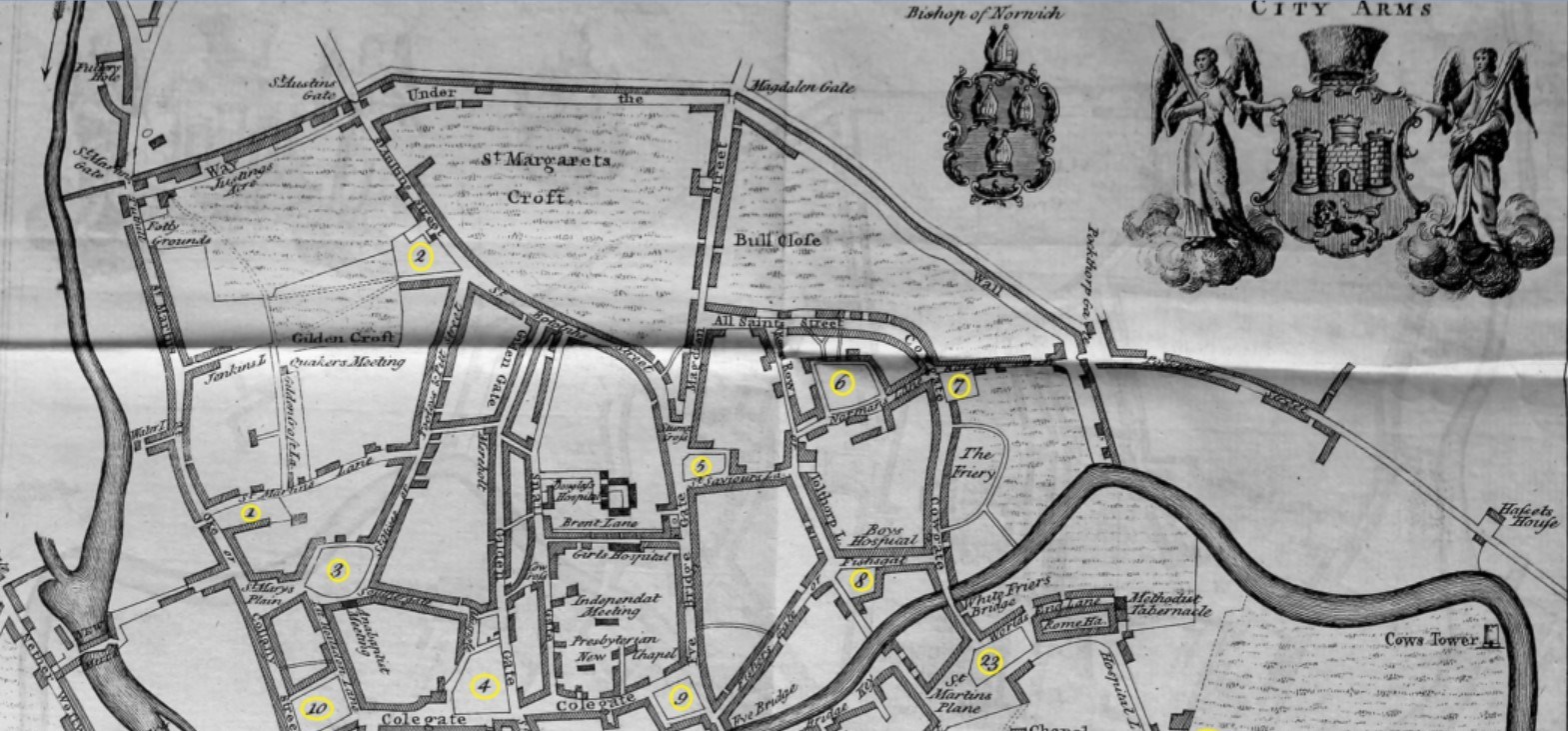
1 – St Martin at Oak, 2 – St Augustin, 3 – St Mary Coslany, 4 – St George Colgate, 5 – St Saviour,
6 – St Paul, 7 – St James, 8 – St Edmund, 9 – St Clement, 10 – St Michael Coslany (aka St Miles)
The Annisons and Reads settled in the northern part of Norwich in the area around St Martin at Oak and St Mary Coslany on this 1781 map. In between St Mary’s and St Saviour’s there is a building marked Douglass Hospital. This is either on the site or close to the alms house where the hotpresser William Annison ended his days. Nigel Goose wrote about it in A History of Doughty’s Hospital, Norwich, 1687-2009 (2010):
Doughty’s Hospital catered in particular to respectable trades and craftsmen rather than to the lowest social echelons… A wide range of male occupations are represented among the inmates at Doughty’s in 1851 and 1861, although of the 48 occupational labels attributed to them in these two years-unsurprisingly in view of the continued importance of textiles in the town and its extended decline were former weavers, while a dyer and a hot presser feature too.
One property in the yards was described in an advertisement for a sales auction in 1844… “A large Freehold Dwelling-house, divided into two tenements, one with a low room and a chamber and attic over the back room, in the occupation of William Annison; and the other has a low room, three chambers, and two attics, occupied by Robert Goodrum. This Lot has the right of using the yard, wash-house, pump, and privy.” (Norwich Mercury, 17 Feb 1844).
Four years later, five owners of property in the Queen Caroline yard, St. Martin’s at Oak (including William Annison) were summoned under the “Removal of Nuisance Act,” for allowing a nuisance to exist in the said yard. Inspector Kemp spoke to the filthy state of the privy, which the parties did not deny, and promised to meet together and make arrangements for its removal. (Norfolk News, 23 Dec 1848).
Evidently things had not improved when a Norwich Mercury reporter visited the yards around Oak Street in 1897: “The stranger gropes his way up one of these passages, and his olfactory nerves soon let him know he has entered upon a new land – a land of stinking slops and refuse of all kinds. The comparatively fresh air of the outside world gives place to an ever-tainted atmosphere which at the first whiff, is well-nigh stifling.”
William Annison the weaver lived in Reeve’s Yard in 1841. In 1891, cottages were still being sold there by auction and the new owners could expect weekly rents of £16 3s per annum, equivalent to £1,325 today. (Norwich Mercury, Sep 1891). In Oct 1898, “Sprite” wrote that “in spite of cooler weather, the Norwich death-rate still remains at the high level of 25 per thousand, with the zymotic mortality more than doubled. What’s the cause? If it isn’t the heat, can it be the open sewers?” He continues, “It’s whispered… that Norwich had two doubtful distinctions… That the ‘city of gardens’ showed the highest death-rate in England from diarrhoea and measles… That Reeve’s Yard, St. Mary’s, offers a good field for the slum reform scheme.” Finally, he tells us of a fatal fire in St Mary’s claiming the life of a baby but observes something heart-warming in the community. Thanks to the “pluck and promptitude of two or three neighbours, other children were saved from harm… Happily, a courageous spirit, and readiness to rescue the helpless at considerable risk, may still be found in the gloomy depths of Reeve’s Yard.” (Eastern Evening News).
 Travels Through Time