
According to Percy Birtchnell and others…
Some of our cherished traditions originated well before Charles Dickens’ portrayal of Christmas. For example, feasting has been part of our celebrations since before the fourth century, when the Bishop of Rome declared 25 Dec to be the day of Christ’s birth. Dickens brings us tales of family, mistletoe and holly, church and charity.[1] Evolving customs since then include trees and lights, carols, cards, Santa Clause, presents and dreaming of a White Christmas. Percy Birtchnell wrote under the pseudonyms Beorcham and Townsman for the Berkhamsted Review bringing us historical references of our town in the festive season, here rounded out with contemporary newspaper reports.
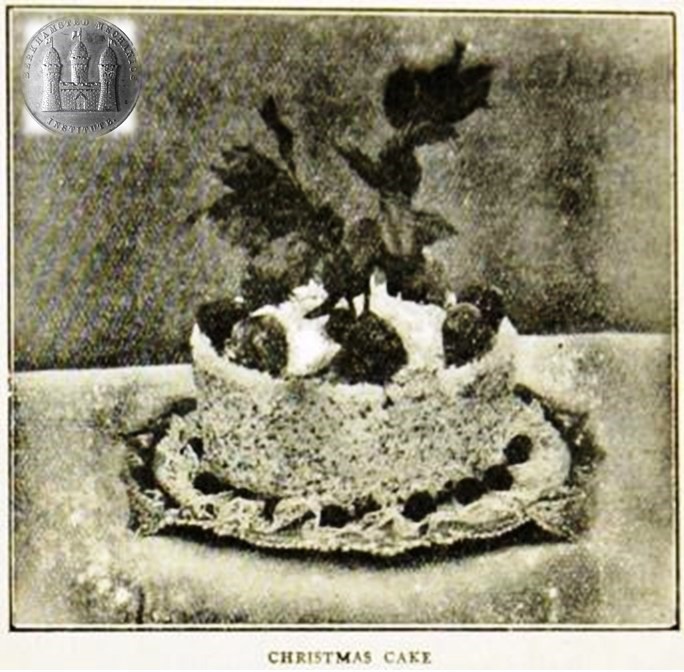
Mechanics’ Institute medal for merit (top left corner) awarded to Mrs Young in 1886
It’s beginning to feel a lot like Christmas… British Schools break up for Christmas vacation. “… the elder scholars had an abundant supply of cake and coffee. A Christmas tree… a magic lantern exhibition… singing, recitations, dialogues, &c., given by the children. (Herts Guardian, Agricultural Journal, and General Advertiser, 1867).
In 1886, the Parish Magazine reported that Bourne scholars… “went up the church tower, and derived great amusement from watching the Christmas market, especially the wilfulness of some of the sheep and pigs, which seemed to have a kind of presentiment of their purchasers’ intention of turning them into Christmas dinners for the people.”
The Gloucestershire Echo in 1949 reported “‘The Makers of Christmas’ produced at the Prestbury Women’s Institute by the pupils of Berkhampstead School. The play consisted of five scenes: The Shepherds, the Magi, the First Christmas Tree, the Coming of Santa Claus, and the Nativity Tableau. These were interspersed by carols, which were sweetly sung.”
Wassail! Wassail! All Over the Town… Duke William was crowned King in Westminster Abbey on Christmas Day 1066, but the Ludlow Advertiser of 1908 places this event in Berkhampstead Castle, describing “our country, smarting from defeat, watching with sullen anger the victorious usurper wassailing in a Saxon stronghold… the bill of fare [giving an] idea of the appetites of the courtiers whose very language was incomprehensible to those about them.”
In Tudor times, probably in the reign of Henry VIII, our Victorian historian John Cobb finds details of a feast at “harry dawnsserris howsse” (Harry Dancer’s house). Three geese cost 1s.6d., and 19 chickens 1s.8d., roughly a penny each. One ounce of pepper, however, cost 3d. There was an additional payment of 1s.6d. for ‘horsemete’ – not horsemeat, but fodder for the horses which brought the guests to the house.
Birtchnell tells us “There were glittering balls in the Town Hall. In turn, every large house held a lavish party, and the balls at Ashridge, Haresfoot, Rossway and other mansions were often dazzling affairs. The servants’ ball… sometimes lasted until it was time for the housemaids to start yet another daily round, cleaning the grates, whitening hearthstones, filling scuttles and starting roaring fires for yet another day of ease and comfort for the fortunate few.”
A lavish repast was provided to employees of Cooper’s chemical works at the Town Hall in 1896, including “roast beef, roast turkey, roast veal, boiled ham, sucking pigs, boiled mutton and caper sauce, roast pork, roast mutton, boiled chickens and white sauce, roast chickens, boiled beef ; plum pudding, rhubarb tart, apple tart, mince pies, blanc-mange, tipsy cake, jellies ; cheese, celery ; dessert.” Birtchnell adds: “And that, I think you will agree, is quite enough!”.
The Bucks Herald reported on the Christmas fare displayed every year by grocers, butchers and drapers. Mr. Cheeld, “next to the ‘One Bell,’ astonished the town every Christmas by hiding the entire facade of their grocery shop behind hundreds of turkeys and chickens”. In 1869, Messrs. Tompkins and Timson had some splendid joints on display, but “the most noteworthy show, and the finest ever seen in Berkhampstead, is that at Mr. Hazell’s establishment… it would be hardly possible to see a finer collection of very superior fat hogs… weighing from twenty to seventy stone each.” In 1875, the drapers made a “rich display of bright warm clothing, and have been doing large business during the week with the members of the clothing clubs”. In 1885, Messrs. Orchard and Procter held their largest “annual sale of Christmas fat stock in the Market-place, comprising twenty-five fat oxen and heifers, a calf, 110 fat sheep and tegs, choice pigs and porkers, and some poultry”.
In 1898, Berkhamsted’s photographer J.T. Newman explains in The Sketch that “the Christmas goose is once more on many a British table” and describes the process of cramming to achieve “a full-sized goose weighing no less than 24 lb.”. In the same year, Newman photographs a farmyard that may well be at Marlin Chapel Farm full of turkeys fattening for Christmas.
The Holly and the Ivy… “It was from the custom of decorating our places of worship with evergreens that the holly takes its name. It was originally known as the holy tree. Mystic and superstitious legends have always hung round the mistletoe, which is commonly described as adorning a stately oak tree, as in the days of the Druids, as a matter of fact is usually found on the humble apple-tree” (Bucks Herald, 1896).
The Bucks Herald often described the parish church being “tastefully adorned” by ladies of the congregation with “variegated holly, richly studded with berries… chrysanthemums and other choice blooms” donated from the conservatories of the local gentry. The font was given special treatment, being decorated in 1892 “with frosted holly mixed with ivy, box, and other evergreens”.
Oh Come All Ye Faithful… A Christmas wedding took place at St Peter’s church in 1897 according to the Bedfordshire Mercury and “was a most cheerful and lively affair… the bride was dressed in a costume of oyster white satin trimmed with Brussels lace and real orange blossoms, and wore a veil of Brussels lace fastened with diamond ornaments, and she carried a handsome bouquet composed of lilies of the valley and orchids”.
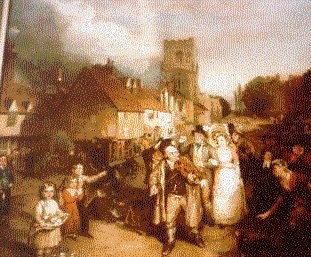
Source: BLH&MS (DACHT : BK7926)
In 1874, “In observance of the extinction of the debt on the Castle Street [Congregational] Chapel, a public tea and meeting were held. Mr. T. Read, who presided, said… to pay off a debt of £300 in seven months was highly creditable to their pastor and church”. (Hemel Hempstead Gazette and West Herts Advertiser).
At Ravens Lane Infants’ School in 1875, “The little folks sang some of their pretty songs, and recited various selections admirably, in the presence of some of the lady friends of the school” (Bucks Herald).
Wartime Christmases were a little different. During World War One, the Infants’ Christmas tree party began and broke up early “owing to the stringency of the lighting order” and the Rector referred to “the entire absence of artificial lighting in the streets.” In World War Two, there was “a truly remarkable programme for evacuated and local children, starting with Christmas Day and Boxing Day dinners in Deans’ Hall, followed by variety entertainments.”
It was Christmas Day in the workhouse… Birtchnell wrote of“Hard winters [bringing] unemployment, poverty and misery to dozens of families. Soup kitchens were installed at Foster’s Brewery (behind the Swan) and in the Castle grounds”. A doctor attending the birth of a baby in Gossom’s End one Christmas Eve in the 1890s “was appalled to find that there was no food in the house”. The father was given half a crown to spend at the grocer’s and butcher’s and the family prayed for a White Christmas so that he could earn a few pennies sweeping away the snow.
When there was no choice but the workhouse, “the inmates were entertained in the usual liberal manner at Christmas, special provision being made for their comfort and enjoyment. Many kind friends sent tea, sugar, tobacco, fruit, sweets, [nuts, cakes, mince pies, ale and toys for the children, pictorial papers], so that the festival was made as enjoyable to both young and old as it possibly could be” (Bucks Herald, 1897).
The Bucks Herald reported in 1881 that, following “extra comforts” provided for the inmates, they were “assembled in the hall to witness the amusing and absorbing representation of ‘Punch and Judy,’ kindly and very cleverly given by the brother of the matron”. In 1909, “The Scarlet Pierrots had given an entertainment to the inmates, who were further entertained on Saturday with a Christmas tree by Miss Alma Smith-Dorrien”, according to the Watford Observer. Meanwhile, “Christmases were lovely” at the Foundling Hospital, with Chinese lanterns, sweets, fruits and presents from the foster mothers (Foundling Museum).
O Christmas Tree… A custom that survives to this day is the Festival of Light. In 2004, John Cook writes of “a silver cup and certificates are awarded by the Citizens Association for the best decorated shop windows, and there is music, dancing and lots of stalls”. Back in the 1960s, Birtchnell celebrates “a cheerful sight; what’s more, rather more tradespeople than usual painted the town red, blue and yellow with coloured lights. What a lot of pleasure the bright lights give – especially on murky nights!”
Parish magazines in the 1880s note the festive season accompanied by music and carols. “St Peter’s Drum and Fife Band saluted the happy morn by playing a selection of music as they marched through the town between midnight and 1 a.m., varying the programme from time to time by stopping to sing carols.”
Other entertainments in years gone by include the Mechanics’ Institute Christmas Penny Readings in the Town Hall. In 1902, the “Progress hall entertainment was well attended, chiefly by young people… Mr. W. Wood contributed some very acceptable gramophone selections, and the chairman, a cultured elocutionist, gave a selection from Dickens’ ‘Christmas Carol’” (Bucks Herald).
In about 1904, one of the first performances of J.M. Barrie’s Peter Pan was staged especially for the Llewelyn Davies boys, one of whom was ill, at Egerton House in Berkhamsted High Street. Barrie always acknowledged that the boys’ free-spirited youth was the inspiration for his play. He wrote on the dedication page of the printed version of the play. “I made Peter by rubbing the five of you together, as savages with two sticks produce a flame”.
With every Christmas card I write… The first card was designed by John Callcott Horsley in 1843 for Henry Cole who was keen to promote the new Penny Post system. The card, now in the Victoria and Albert Museum, depicts a family Christmas dinner.
In 1941, Birtchnell wrote about “Christmas cards [depicting] ‘coaching’ scenes… a handsome stage coach full of cheerful Pickwickian folk is about to draw up outside a romantic old inn, and ‘mine host’ walks out into the glittering snow to greet them all with an expansive smile.” The postmaster at the King’s Arms Hotel in Berkhamsted would lower letter-bags from his bedroom window and “on one occasion he made the mistake of throwing his trousers out of the window into the arms of the astonished coachman – definitely the wrong sort of ‘male bags’!”
By 1975: “The Christmas greeting card trade may not be so brisk now that we have to pay 6.5p for a stamp, but at least we have a variety of local scenes to make a change from robins, holly, and ye olde coaching inn”. Harry Sheldon (1917-2002) and George Sear (born 1937 in Berkhamsted) were two local artists who provided snowy scenes of the canal, Berkhamsted School, the Court House and Northchurch.
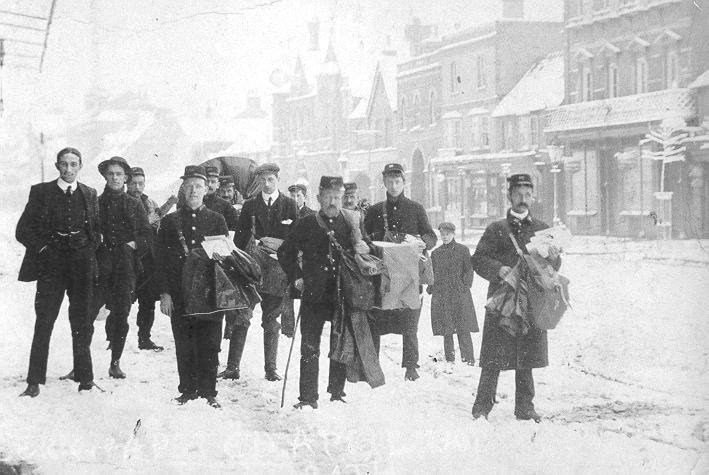
Frederick Howard the postmaster 1891-1911
Source: BLH&MS (DACHT : BK6673)
Sleigh bells ring, are you listening?… In 1887, the Bucks Herald reported that “Mr. E.H. Smith drove through the town with two companions in [a sleigh] as high as a dog cart, the bells at the horse’s head merrily jingling. Mr. A.G. Lucas, Ashlyns, also had one, the trace horse being distinguished by coloured plumes and tassels.”
Birtchnell wrote that parents and children started thinking about Christmas months ahead and many presents were home-made and very simple. “Lucky indeed were the children of Berkhamsted’s many woodworkers, whose dolls’-houses and toy trains were often better than those sold in the shops.” Then as soon as one Christmas was over, “people started thinking of the next, joining coal and clothing clubs, usually run by a church or chapel, and paying a few coppers weekly or fortnightly for a spending spree at Christmas.”
De Fraine’s bazaar in 1906 advertises in the Bucks Herald: “toys, games, leather, china, metal, silk, and satin goods, and all sorts of pretty and inexpensive articles… a great variety of Christmas annuals, diaries, almanacks, and calendars” while in 1921, “Charming blouses and jumpers, in silk and crepe-de-chine. Fancy linens. Children’s dainty party frocks. Ladies’ and gentlemen’s gloves, handkerchiefs” were available in Wheeler Bros. of Lower King’s Road.
Walking in a winter wonderland… Seasonal weather is the subject of many musings by Birtchnell and the local press. “In one thing Dickens was exactly right when he described the air of ‘jollity’ which prevails when the snow descends”, declared the Buckinghamshire Examiner in 1924. Although “the buses found it impossible to go from Chesham to Berkhampstead [the] happiest sight of all was to see the Grammar School students crowding into the newly-covered, cosy ‘Pride of Bucks’ charabanc – snow, what cared they!”
With canal and castle moat as icy venues we learn from Birtchnell of skating galas “with fairy lamps twinkling and many a bonfire on the towpath to warm by-standers. St Peter’s Band sometimes attended, and baked potatoes and hot coffee were supplied by William Fisher, who tempted providence by setting up a brazier on the ice”.
In 1887, Wilstone and Marsworth Reservoirs were declared “quite safe for skaters” by the Bucks Herald. In 1895 “Skating and Sliding on the Canal, the Moat at the Castle, and the ponds of the neighbourhood, have been favourite pastimes, also tobogganing where practicable. There have been a few immersions and any number of tumbles, several taking place in the slippery streets.” In 1936 the Western Times reported: “By arrangement with the Office of Works a ban on skating over the Castle moats at Berkhamstead has been removed.”
A waggon load of fat hogs was being drawn down Gravel Path in 1879 when (according to the Bucks Herald) the horse “slipped on its haunches, and was driven almost from the top to the bottom of the pitch. Strangely enough it was extricated unhurt.”
A-hunting we will go… In 1865, the Herts Guardian, Agricultural Journal, and General Advertiser reported from the Petty sessions at Great Berkhamsted “an unusual number of prosecutions under the Game Laws, which sound to the mind’s ear, singularly like the poppings of rabbit-shooting squires. Only in these cases, the game did not consist of rabbits, but chiefly of rabbit-killers. Sydney Humphrey and Frederick Austin were charged with trespassing in search of conies, on land belonging to Earl Brownlow. Pop! pop! They were knocked over, right and left, convicted and sentenced.”
According to the Bucks Herald in early 1873, Baron Rothschild’s hounds had a grand run from Rowsham through stiff country to Ockridge Wood. On the same day, the Berkhampstead Buckhounds met at Cross Oak and had achieved a racing pace through Pancake and Ockridge Woods. Approaching Haresfoot Park, the two packs met. “‘Hullo, Dick!’ says Fred Cox, ‘you are hunting our stag!’ ‘Hullo yourself,’ says Dick; ‘How the blessings do I know we’ren hunting your’n, or you aint hunting our’n!’. A moment’s blank look, and all joined heartily in the laugh at so unexpected a collision.”

Source: BLH&MS (DACHT : BK8324)
Auld Lang Syne… “The Berkhampstead Volunteer Band played suitable music on New Year’s-eve, and the bells ushered in the year 1887 with merry peals.” Servants and tenants were treated to pieces of beef, Christmas dinner and seasonable gifts by their beneficent employers and gentry from their estates on the surrounding hills.
Ten years later, according to the Bucks Herald, the Parish Council was exercised by the antics of the Town Crier, inquiring whether “if some stupid person chose to give him a shilling, he was obliged to cry anything he was asked to”. As a public officer employed by the Vestry, “he should not be allowed to bring his office into ridicule, as he had done on various occasions. A man ought to conduct himself properly, and a caution might be given.”
In the last Berkhamsted Review of the year in 1980, Birtchnell wrote “After the watchnight service at St Peter’s on the last day of the year, worshippers (and revellers!) would gather under the yew tree, and as the church clock struck twelve everybody joined hands and sang ‘Auld Lang Syne’.”
[1] Flanders, J., ‘Victorian Christmas’, British Library (2014)
 Travels Through Time