
Writing as Beorcham, local historian Percy Birtchnell produced articles for the Parochial Review and Berkhamsted Review from Jul 1941 to his Memoriam article in Apr 1986.
Around about 2017, Bill Willett took on the task of scanning these articles so as to make them accessible to everyone, rather than hidden in the depths of local museums and libraries. They are available on this website and here is the Beorcham index. Then, as with all searchable pdf files, just use control-F to bring up the search box.

Beorcham’s first words for the Review in 1941… “Isn’t it just like Berkhamsted to hide its most picturesque building behind a row of shops? The Court House is so old that no one can safely estimate its age. It was often the scene of great parish feasts, where oxen were roasted whole.. the turner of spytys (spits)… received the princely sum of – twopence!”
Included in Birtchnell’s treasure-trove of local history are glimpses of Peter the Wild Boy (here is his remarkable story as told by Lucy Worsley). The 200th year since his death was commemorated by Northchurch History Society in 1985.
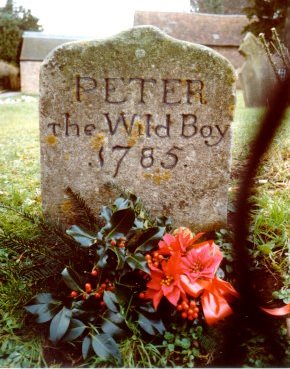
Beorcham wrote: “I am always sad when I see his gravestone facing the door of St. Mary’s Church, but inside I like to read once again the brass memorial tablet which tells us that the ablest masters were provided for Peter, ‘but proving incapable of speaking or of receiving instruction, a comfortable provision was made for him by Her Majesty at a farmhouse in this parish, where he continued to the end of his inoffensive life.’ A very nice epitaph.”
Percy Birtchnell was introduced to Parochial Review readers in Jul 1941: “… a talented local writer has generously offered to contribute to the ‘Review’ a series of articles on Berkhamsted’s links with by-gone days. His nom-de-plume is particularly appropriate – ‘Beorcham’ is a very early way of writing the town’s name.”

Jennifer Sherwood wrote a biography of Percy Charles Birtchnell in the Chronicle, Vol. I, pp.6-9:
Percy Charles Birtchnell was born in Highfield Road Berkhamsted [in 1910], the son of an outfitter’s assistant. He attended Chapel Street Infants’ School then Victoria Boys’ School, where he later became a Bourne scholar. There he developed an interest in history, especially local history. He began writing at an early age; his first articles appeared in the local press when he was only fifteen years old. He is perhaps best known for his contributions to the Berkhamsted Review where he wrote under the pen name “Beorcham”, an early spelling for Berkhamsted. He served a seven years’ apprenticeship as a compositor at Cooper’s printing works (later the Clunbury Press) and later became a monotype keyboard operator, one of the fastest in the country. Shortly before the outbreak of the Second World War, he opened a men’s wear shop in the newly built Rex parade and installed his father to manage the shop, which he later took over. His great interest in local history led him in 1950, together with other likeminded people, to form the Berkhamsted & District Local History Society of which he was secretary until a few weeks before his death. Bob Clark, later the owner of Birtchnells, summed him up , “He loved his town, his church, the schools and its history, both ancient and modern, but probably above all, the people, for it is the people not things which surely make a town what it is.”
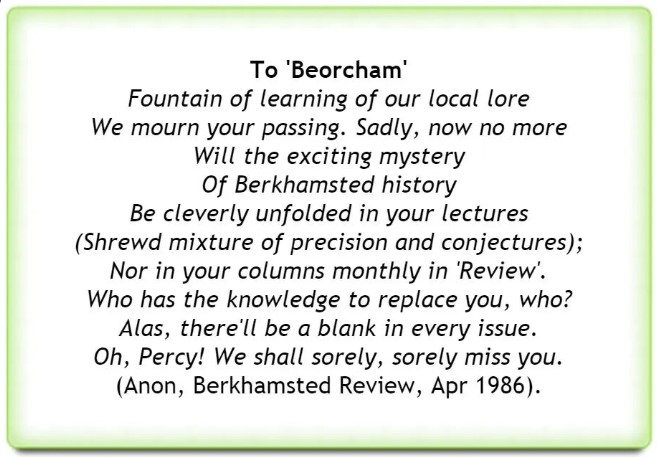
He was highly regarded in the town, as evidenced by this tribute, written by the Editor of the Review in Apr 1986:
“On 12th March in Berkhamsted everyone who heard the news of Percy Birchnell’s death was affected – how sorry people were. He was a kindly man, always seeking the quieter ways of life; punctilious about detail – no editor of the Review dared face him when there was a printer’s error in his ‘Beorcham’ articles – but with a wry sense of humour which lightened all that he did. I suppose we could truly call him ‘Mr. Berkhamsted’: he was born in the town, educated in the Bourne School and worked here all his life. His two best known books, A Short History of Berkhamsted and Bygone Berkhamsted reflected both his love of his birthplace and his careful eye for detail in researching its history.”
 Travels Through Time